
I run a small fleet of AI agents in my business. Not one chatbot, several hard charging specialists, and each has its own job. One drafts, one researches, one handles design, one ships. They do real work for me every day.
Running more than one agent creates the same conditions as running more than one employee. They have to talk to each other. If my research agent turns up something my writer needs, there has to be a clean way to hand it off. If an agent gets stuck, it needs to ask another one for help, or flag me. Without that, I'm stuck in the middle of every little handoff, and the whole point of automation falls apart.
What I built first, and why it wasn't enough
My first version that I previously wrote about was homegrown. I wired up a simple message file that the agents wrote to and read from. Agent A drops a note, Agent B picks it up. It worked for a while.
Then it started to creak. There was no real inbox, so when I needed to see what actually happened behind the scenes, I had nothing easy to search. Threads got tangled. When something broke I had to dig through files to work out who said what to whom. And every time I added an agent, the whole thing got more fragile. It was duct tape at best and I knew it.
So I switched to real email
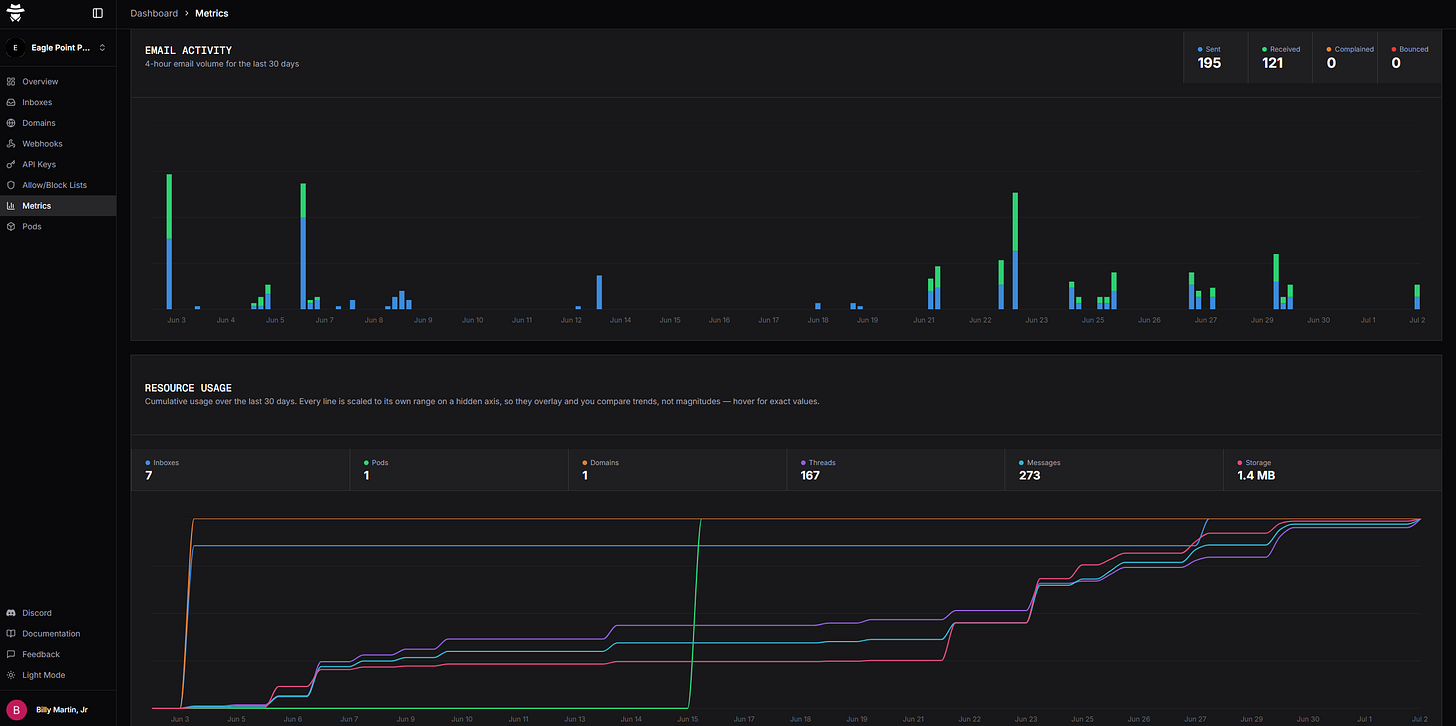
What I use now is a paid service called AgentMail. I’m becoming a huge fan of build before you buy, but I do have a few exceptions. AgentMail is email infrastructure built for AI agents, so each of my agents gets their own real inbox and address. They send and receive messages the way people do, with real threads, a searchable history, and a way to pull in a human when they need one.
Now instead of scribbling in a shared file, my agents email each other. My research agent emails my writer with the source material. My writer emails me when a draft is ready for a human eye. All of it sits in a real inbox I can go back to. If I want to know why something happened last Tuesday, the thread is right there.
How I actually use it
Most of it is handoffs. One agent finishes its piece and emails the next agent the actual work, not a summary of it, and that agent picks up and runs. When an agent hits something outside its lane, it emails whichever agent owns that lane instead of guessing or stalling out. And when a decision is mine to make, one of them emails me directly. I answer from my phone like any other message and the work keeps moving.
The quiet benefit is the paper trail. Because it's real email, I end up with a durable, searchable record of every exchange. Anyone who has tried to debug a system of agents knows how much that history is worth.
The honest pros and cons
On the plus side, it's the difference between agents that quietly coordinate and agents I have to babysit. Each one gets a real identity, the searchable history has saved me hours more than once, and because it runs on plain old email, it plays nice with everything else I already use.
There are tradeoffs, because there always are. Email isn't instant, so if you need millisecond back-and-forth comms between agents, this isn't the tool for that. If you're only running a single agent, you also don't need any of this yet. You're also leaning on a young company, which is a bet, though it's been a good one for me so far. And it's another budget line item, though a small one, which brings me to cost.

What it actually costs
Here's the honest part. You can start for free and probably be very happy for a bit. The free plan gives you 3 agent inboxes, which is plenty to see whether this fits how you work. If you need more room, the Developer plan is $20 a month for up to 10 inboxes, and that's the one I'm on. The Startup plan jumps to $200 a month, but that's built for a small company running upwards of 150 inboxes, so most people reading this are a long way from needing it.
If you want to try it
Fair warning, as I said I use AgentMail, I like it, and there's a referral perk in this for both of us, so weigh my recommendation accordingly. It's still a real one.
The perk lives up at that Startup tier. If you're building something big enough to land there and want to try it, don't just sign up on the site. Email the co-founder, Adi Singh, at adi@welcome.agentmail.cc and tell him Billy at Billy@eaglepointpublishing.com sent you. Referred startups who go that route get three months free on the Startup plan, which is about $600 on the house, assuming you meet their normal eligibility. If you're starting small like most people, start free or on the $20 plan and don't sweat any of that yet. (I’m guessing if you email the co-founder and tell him you want the Developer level with a month or two free to try it out, he might just give it to you. He emails me at least once a week asking how he can improve the tool’s service, so very engaged.)
The bigger point
The reason I bother with any of this is simple. I want my agents doing the work, and that includes the work of coordinating with each other, so I'm not the bottleneck. Getting them to talk to each other on their own is a big part of how a one-person shop starts to run like a bigger one.
If you're trying to get AI actually earning its keep in your business instead of just talking about it, that's what we do at Eagle Point Publishing. But even if you never call us, get your agents talking to each other. That's the unlock.
Originally published on IT Matters
← All writing