I was reading a press release the other day about how Google and the hamburger chain Wendy’s were partnering by installing conversational AI chatbots at their drive thru windows to take customer orders. This came out around the same time that Wendy’s announced it was restructuring its over 7,000 global restaurants with some personnel cuts.
I wrote an article recently about Amazon One and how I interfaced with it at the supermarket and given that my job as a night grill man at Wendy’s was my first paying gig at the age of 15, it got me to thinking about how else I might interact with AI when it involves food. Since this Wendy’s experiment is only being piloted in Ohio it might be a while before I’m able to observe this directly. However, this doesn’t diminish the many ways we’re already all interacting with AI in the food industry, whether we know it or not.
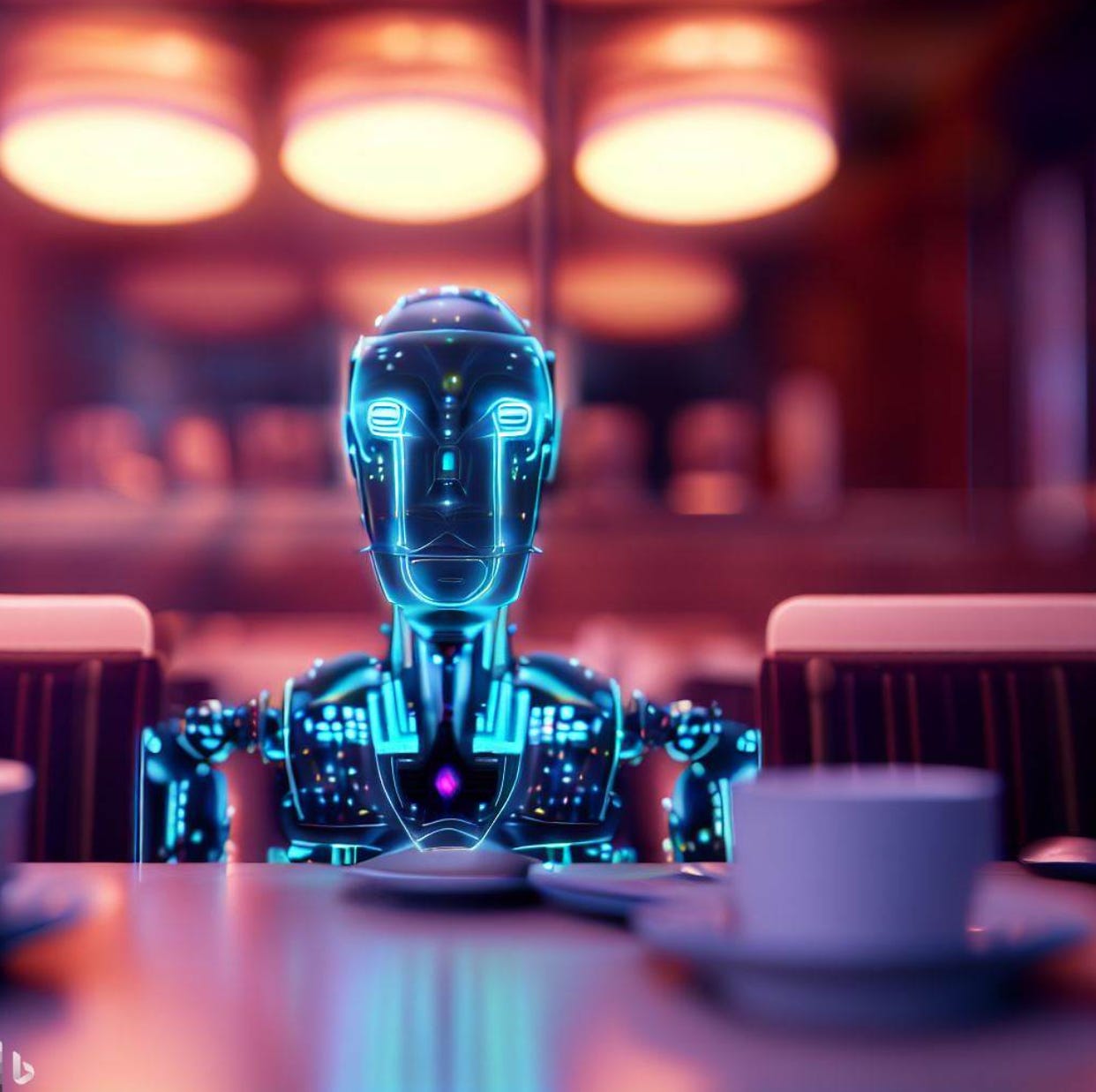
Image: Bing Image Creator
Why would AI even be used at this point in the food industry? According to popmenu, there are at least five great reasons:
Cut costs: AI technology can be used to automate a lot of simple and rote tasks (like taking reservations or entering orders into the POS). This means less money spent on staffing your restaurant, and lower costs overall.
Reduce errors: Human error accounts for a lot of things that can go wrong in a restaurant. For example, a server in a busy dining room might mishear a guest's order, resulting in the guest receiving the wrong dish. When guests order via AI, there's less opportunity for human error.
Customize orders: AI gives more control to guests during the ordering process. This allows them to customize their orders (and their overall experience) to fit their needs.
Improve guest service: By embracing AI's ability to perform simple and rote tasks in your restaurant, you can free up employees to do what they're best at (and what AI can't just yet): Focus on your guests and provide them with the best possible experience. For all the talk about robots being poised to take over restaurant kitchens, there's one thing they definitely can't do yet: Mimic the human touch that can make a restaurant experience so special.
Find new customers: AI technology can supercharge your restaurant's marketing efforts, allowing you to identify what kinds of customers might love your food, reach out to them, and encourage them to pay you a visit. AI can also help with retaining guests—remarketing efforts can encourage them to make a repeat visit after coming to your restaurant.
In addition to these front-end uses, AI can be used on the backend to manage logistics that improve resource requirements and decrease food waste. Three logistical use scenarios where AI technology solutions curb food waste include:
Purchase to meet inventory needs
AI is able to consider several variables when purchasing ingredients and other wares necessary for a restaurant business to function. In contrast to human restaurant operators, AI technology constantly monitors the inventory and only purchases the items that are needed. AI can also account for expiration dates, seasonal preferences, and many other factors.
Strategic offering of menu items
Since AI can monitor inventory, it can use this information to personalize the customer experience while also saving on resources. A smart online ordering system can decide what food choices to offer customers based on current inventory. By adjusting inventory purchases to prioritize items that sell better, AI can reduce the amount of food that is not consumed.
Optimizing the menu
Artificial Intelligence can report on the performance of menu items, giving restaurant operators a clear idea of what is selling well and what isn’t. Not only is this great to know what items are popular, but it also lets restaurant operators know what options should be reconsidered. This optimization process can lead to more products selling, thereby reducing food waste..
So, identify what the customer wants, adjust offerings on-the-fly based on what is available and track how effective the system is, rinse and repeat.
One of the shows I love watching is Restaurant Impossible and too many times I’ve seen episodes where the restaurant being fixed up doesn’t have a Point of Sale (POS) system which seems like such a baseline requirement these day. It’s going to get to the point very quickly where the system will need to also be fully integrated with AI to drive the additional value necessary to stay competitive.
This isn’t just for sit down restaurants either. With the increase in autonomous food delivery services, AI will be used to optimize delivery routes and handling customer communications. Never seen an autonomous food delivery vehicle in your neighborhood? Neither have I. And while it may seem like this whole AI industry is all talk and no action there are already multiple producers of AI-incorporated food-related robots and applications that are actually in production environments. Even existing vendors like Soundhound with their Restaurant Voice Assistant are finding ways to evolve their products to serve the industry.
The future of the food industry is coming into focus as artificial intelligence grows increasingly popular. AI is rapidly changing the way restaurant chains, food manufacturers and other businesses operate.” - The Food Institute
Artificial intelligence is changing the way we interact with technology, and the way that technology helps us to produce and consume food. From reducing food waste, to creating personalized menus and enhancing customer service, AI is rapidly transforming the food industry. To remain competitive every participant will have to embrace AI as an opportunity for innovation and improvement, while also being aware of its limitations and responsibilities. By doing so, participants can ensure that AI will serve as a tool for creating more sustainable, healthy, and diverse food options for everyone.